
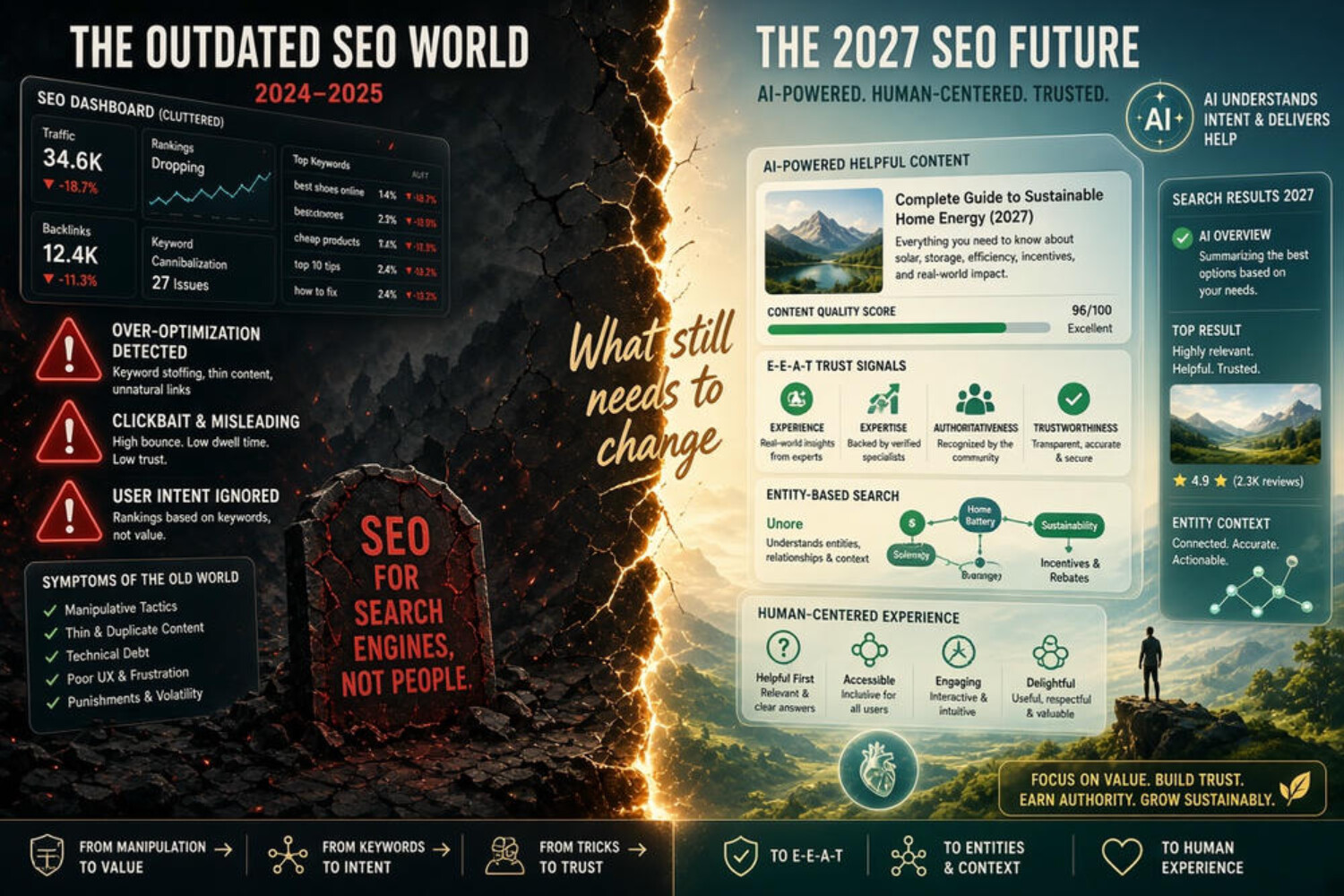
As we navigate the current landscape, evolving seo practices require a complete mindset shift to match the realities of modern search. The search landscape is undergoing its most profound transformation since the inception of the web index. As we look ahead toward 2027, the mechanics of discovery are no longer confined to ten blue links, static keyword queries, or traditional ranking factors. Generative artificial intelligence engines, personalized discovery feeds, autonomous agentic browsers, and multimodal search experiences have altered how humans interact with information. For more background on search mechanics, read this W3C architecture overview.
Yet, despite this technical revolution, much of the digital marketing industry remains chained to legacy playbooks. Tactics developed for the 2010s are repeatedly repackaged with new acronyms, leaving brands ill-equipped for the emerging reality of decentralized discovery. Furthermore, practitioners often fall prey to common SEO misconceptions that hinder long-term growth.
Understanding evolving seo requires more than just tracking the latest algorithm updates—it demands a fundamental overhaul of how we define relevance, measure success, and build web ecosystems. Here is an in-depth examination of the state of search and what needs to change if brands want to thrive leading up to 2027.
1. The Reality of Search in 2027: The Rise of the Synthesis Layer
Search is no longer a simple matchmaking service between an input keyword and an index of URLs. Search engines have evolved into synthesis engines.
[User Query / Prompt]
         │
         ▼
[AI Synthesis Layer: Retrieval-Augmented Generation (RAG)]
         ├── Direct Answer / Action Execution
         ├── Multimodal Assets (Video, Audio, 3D)
         └── Curated Citations & Entity Sources
Users increasingly receive synthesized answers directly on search engine result pages (SERPs) or through direct conversational assistants. When an AI interface can directly book a reservation, compare technical specifications, or summarize complex legal frameworks, user visits to standard content websites become deliberate, high-intent actions rather than casual browsing sessions.
The primary challenge of evolving seo is understanding that search volume does not equal search traffic anymore. If your strategy relies solely on capturing informational clicks through basic definitions and listicles, your visibility model will collapse. Evolving seo practices require marketers to adapt continuously.
To master evolving seo, brands must evaluate how modern discovery channels function. When implementing evolving seo, digital teams should audit existing schemas. Executing evolving seo properly involves looking beyond basic metrics. Every professional practicing evolving seo needs robust data frameworks. The future of evolving seo depends entirely on structural readiness.
Additional adjustments in evolving seo focus on semantic relevance. Without adopting evolving seo principles early, websites risk losing visibility. Modern practitioners of evolving seo understand the value of knowledge graphs. Embracing evolving seo ensures long-term organic stability. Tracking evolving seo metrics requires specialized tooling. Ultimately, evolving seo transforms raw data into actionable insights.
Furthermore, maintaining momentum in modern digital ecosystems requires continuous testing and adaptation. Webmasters must review technical parameters regularly to ensure seamless compatibility with search crawlers and large language models alike. By keeping a close eye on industry developments and algorithm shifts, organizations can safeguard their digital footprint against unexpected volatility.
Building sustainable online authority also involves cross-functional collaboration between content creators, developers, and data analysts. When every department understands the core objectives of modern search visibility, execution becomes streamlined and significantly more effective. This comprehensive alignment bridges the gap between theoretical planning and measurable real-world performance.
2. Strategic Shifts: What Needs to Change in SEO Mindsets
To survive and grow, marketing leaders must abandon legacy mental models. The gap between what modern search systems reward and what marketing teams execute is widening significantly across competitive industries.
From Keyword Matching to Entity Authority
Keywords are merely representations of concepts; algorithms now understand the underlying entities themselves. Search platforms maintain vast knowledge graphs that map relationships between people, organizations, concepts, and products.
- Legacy Approach: Researching high-volume keywords, mapping them to specific URLs, and repeating target phrases within the H1, body text, and meta description.
- Modern Approach: Establishing topical authority across a domain by mapping comprehensive semantic relationships. The goal is to become recognized by search models as the authoritative entity on a given subject.
If a cybersecurity company wants to rank for enterprise cloud protection concepts, publishing ten superficial blog posts targeting individual long-tail keywords will no longer work. Instead, they must publish verifiable research, host original benchmark data, and earn contextual citations across peer-reviewed and industry platforms to cement their entity status.
Redefining the Zero-Click Paradigm
The zero-click search was once viewed as an existential threat. In the 2027 landscape, zero-click discovery is the primary mode of brand awareness.
Marketers must stop treating zero-click SERPs as lost traffic and start treating them as prime brand real estate. When an AI overview synthesizes your methodology, names your framework, or quotes your founder as the authority, you have gained mental availability. What needs to change is the outdated expectation that every consumer interaction must register as a pageview in Google Analytics.
Adopting evolving seo strategies helps mitigate zero-click losses. When teams integrate evolving seo into content planning, visibility increases organically. A solid evolving seo foundation supports diverse marketing channels. Successful brands treat evolving seo as an ongoing core discipline.
As user behavior continues to shift toward conversational and ambient interfaces, the definition of success must expand beyond traditional click-through rates. Brand mentions, referral visibility within model outputs, and direct entity associations carry immense weight in determining long-term digital viability and trust.
Organizations that embrace these paradigm shifts early will position themselves advantageously as artificial intelligence tools become the primary gatekeepers of consumer intent. Cultivating deep subject matter expertise and publishing transparent, verifiable data points will remain the bedrock of sustainable organic growth.
3. Technical Evolution: Beyond Standard Web Vitals
Technical SEO has progressed far beyond simply fixing broken links and optimizing robots.txt files. As AI-powered crawlers and large language model (LLM) agents navigate the web, technical infrastructure must adapt to machine consumption.
+-------------------------------------------------------------+
|               2027 Technical SEO Architecture               |
+------------------------------+------------------------------+
| Human User Layer             | Machine Agent Layer          |
| - Fast rendering (Core Vitals)| - Dynamic JSON-LD Graphs     |
| - Intuitive UX & Design      | - Machine-readable APIs      |
| - Accessible Content Flows   | - Semantic HTML & Microdata  |
+------------------------------+------------------------------+
Machine-Readable Data Structures
Standard schema markup is no longer optional—it is the foundational language of AI retrieval. To optimize for evolving seo architectures, websites must implement nested, interconnected structured data.
- Connected Entities: Link your authors directly to their academic papers, social profiles, and Wikidata entries using
sameAsschema. - Granular Product Graphs: Provide real-time inventory, dynamic pricing, and compatibility attributes formatted specifically for autonomous shopping agents.
- Content Provenance: Mark original claims, data sets, and primary sources with explicit structured data to help retrieval systems verify truthfulness.
Optimizing for Agentic Browsers
Autonomous AI agents now browse the web on behalf of human users to complete complex tasks—such as finding a specific B2B software package that integrates with a legacy tech stack and fits a precise budget.
If your website relies on heavy client-side JavaScript rendering, gated product details, or obscure interactive elements that confuse machine parsers, automated agents will simply skip your site in favor of an accessible competitor. Technical SEO must ensure frictionless data access for both human visitors and autonomous bots.
Ensuring fast execution of evolving seo enhancements protects rankings. Technical audits under evolving seo guidelines reveal hidden bottlenecks. The scope of evolving seo spans server response to DOM delivery.
Furthermore, maintaining clean server logs and monitoring crawler behavior provides invaluable diagnostic insights. Understanding how search bots and automated agents interact with your site architecture allows engineering teams to resolve rendering issues before they impact overall visibility.
4. Practical Examples: 2027 Workflows in Action
To understand the practical application of these shifts, consider how two different business models must transform their strategies.
Example A: The B2B SaaS Workflow
- The Old Playbook: Target “Best CRM for real estate agents.” Write a 2,500-word article with affiliate links, stuffed with generic advice and basic comparison tables.
- The 2027 Workflow:
- Produce Primary Data: Run an annual benchmark report analyzing transaction closure rates across 1,000 real estate brokerages.
- Format for Synthesis: Package the findings into clear data tables, downloadable CSVs, and explicit summary blocks that AI models can ingest and cite easily.
- Build Entity Proof: Have verified real estate industry experts co-author the report and speak about it across industry podcasts and specialized publications.
- The Result: When a buyer asks an AI agent, “Which CRM produces the lowest lead-to-close latency for regional brokerages?” the model cites the SaaS company’s benchmark report directly, positioning the brand as the undisputed solution.
Example B: The Specialty E-Commerce Retailer
- The Old Playbook: Write hundreds of keyword-optimized category pages like “durable leather hiking boots” with repetitive boilerplate copy at the bottom of the page.
- The 2027 Workflow:
- Deep Product Attribution: Populate product feeds with comprehensive details (e.g., leather grade, waterproofing certifications, sole tread depth in millimeters, repairability index).
- Community Feedback Loops: Aggregate and structure verified customer reviews highlighting specific use cases (e.g., “held up in sub-zero alpine conditions”).
- Visual & Multimodal Optimization: Provide 3D product models, short video demonstrations of real-world use, and machine-readable spec sheets.
- The Result: Multimodal search tools can immediately match a user’s uploaded photo of rugged terrain with the retailer’s boots, citing specific user reviews detailing performance in that exact environment.
Executing these workflows proves that evolving seo is practical. Brands implementing evolving seo see higher trust metrics.
By shifting focus toward tangible value creation and structured data transparency, organizations can consistently outperform competitors who rely on outdated optimization tactics.
5. Analytics and Measurement: What Needs to Change
You cannot manage what you do not accurately measure. Relying on organic traffic graphs and vanity ranking positions will produce flawed business decisions.
| Traditional Metric | Why It Is Obsolete | Modern 2027 Metric | Strategic Value |
|---|---|---|---|
| Average Keyword Rank | AI overviews and personalized results make single-rank tracking meaningless. | Share of Model (SoM) / Citation Frequency | Tracks how often your brand is cited as the primary source in conversational AI answers. |
| Total Organic Sessions | Zero-click answers reduce informational site traffic regardless of ranking. | Qualified Downstream Conversions | Measures high-intent visitors who arrive ready to buy or engage after research. |
| Raw Backlink Counts | AI systems prioritize content quality, entity context, and source truth over link quantity. | Entity Brand Mentions & Contextual Co-occurrence | Validates domain credibility across independent, authoritative knowledge graphs. |
| Bounce Rate | Visitors often arrive to verify a single data point and leave satisfied immediately. | Task Completion Rate & Engaged Time | Measures whether the user achieved their explicit goal on your page. |
Analytics teams must adapt evolving seo measurement techniques to reflect modern attribution.
Tracking these advanced indicators requires sophisticated internal dashboards and data warehousing capabilities. Connecting disparate data sources provides a holistic view of true marketing impact.
6. Content Creation: Moving Away from Commodity Copy
The marginal cost of producing generic text has dropped to zero. If an article can be entirely generated by a basic prompt, it provides zero unique value to a search ecosystem already saturated with synthetic content.
What Needs to Change in Editorial Strategies:
- Mandate First-Person Experience (Information Gain): Algorithms prioritize content that introduces new information to the web index. This includes proprietary experiments, real-world case studies, original photography, and firsthand accounts.
- Design for Non-Linear Reading: Readers and machines look for immediate value. Use distinct summary cards, structured data tables, clear sub-headings, and actionable takeaways instead of long, decorative introductions.
- Eliminate Content Inflation: Do not write 2,000 words when an answer requires 200 words and a clean diagram. Synthesis engines reward concise clarity over artificial length.
High Information Gain Content:
[Original Data / Case Study] + [Expert Analysis] + [Structured Key Takeaways]
= High Authority Citation

Low Information Gain (Commodity) Content:
[Rewritten Competitor Top 10] + [Generic Definitions] + [Keyword Stuffing]
= Filtered by Quality Classifiers
High-quality editorial output remains central to winning evolving seo campaigns.
Furthermore, editorial teams must prioritize rigorous fact-checking and transparent sourcing. When every claim is backed by verifiable data and expert commentary, the overall trustworthiness of the domain increases exponentially.
Conclusion: Embracing the Future of Search
The discipline of optimizing for discoverability is not dying; it is maturing. Evolving seo requires abandoning easy shortcuts, automated content spin cycles, and outdated ranking metrics.
To build an enduring digital presence for 2027, the focus must shift entirely to value creation, entity credibility, technical accessibility for machines, and high information-gain content for humans. The search engines and AI agents of tomorrow will prioritize sources they can trust implicitly. Ensuring your brand earns and proves that trust is the single most important change you can make today.
